Florida Climate Risk Scores: How Agents Should Prepare
JGRES Agent Briefing
Climate Risk Scores on Florida Listings: What Agents Need to Know Before the Buyer Asks
Your buyer is going to see a number from 1 to 10 next to that house. Florida just sued the company behind it. Here is how to be the calm, prepared agent in the room.
By Joaquin Gutierrez, Licensed Florida Real Estate Broker & Founder of JGRES · November 20, 2026
What is a climate risk score on a real estate listing?
A climate risk score is a 1-to-10 rating from First Street, a private data company, that estimates a home's risk from flood, fire, wind, heat and air quality over about 30 years. It appears on Realtor.com, Redfin and RiskFactor.com. On October 23, 2026, Florida sued First Street, claiming the scores are misleading.
1–10Score scale for each risk
5Risks scored: flood, fire, wind, heat, air
30 yrsAbout the life of a standard mortgage
$10K–$15KPenalty per violation Florida is asking for
Picture this. You are showing a beautiful three-bedroom in a neighborhood your buyer loves. In the car, they pull up Redfin and say, "Wait, this house is a 7 out of 10 for flooding. Should we run?"
If you freeze, you lose trust. If you brush it off, you could lose your license. This guide shows you the middle path: know the facts, show the sources and let the buyer decide with real information.
What Happened: The Lawsuit in Plain English
Florida says the scores are hurting homeowners. The state's complaint makes four main points:
Too confident. First Street presents its scores as accurate and scientifically proven, but the state says the models have big uncertainties and sometimes give strange results.
Hidden details. The limits of the model are not clearly explained, and the deeper details sit behind a paywall.
Real money impact. The scores can change whether someone buys, how much they offer and what insurance quotes they receive.
No way to fix it. First Street generally does not change a score just because an owner disputes it.
The state's favorite example: a property First Street rated as major flood risk, while FEMA rated it as minimal flood hazard. Nebraska's attorney general filed a similar lawsuit about two months before Florida did.
Florida is asking the court to stop First Street from claiming accuracy without disclosing uncertainty, to return money to consumers, to impose civil penalties of $10,000 to $15,000 per violation and to hold a jury trial. At the time this was written, First Street had not publicly responded.
What the Score Actually Measures
First Street's "Risk Factor" gives nearly every property in the country a separate score for each risk. Think of it like a weather forecast stretched over 30 years. It is a prediction from a computer model, not an inspection of the actual house.
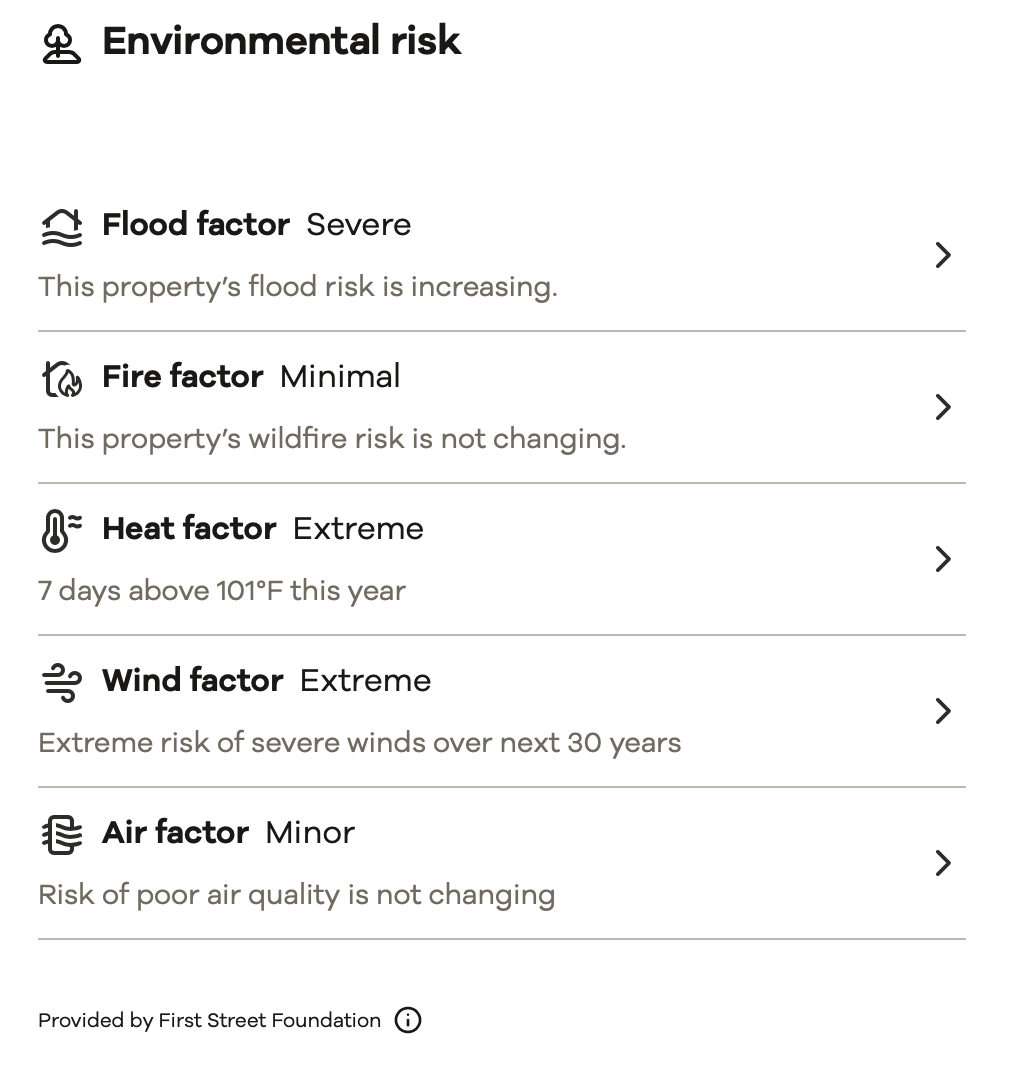
Flood Factor — the one that matters most in South Florida.
Wind Factor — hurricane and storm wind exposure.
Heat Factor — how many dangerously hot days are expected.
Fire Factor — wildfire exposure (usually low in urban South Florida).
Air Factor — air quality.
Where Your Buyers Will See It
Realtor.com: An "Environmental Risk" section on the listing page shows each score from 1 to 10.
Redfin: Shows First Street climate risk data right on the listing. Redfin has defended keeping it.
Zillow: Removed some of the native scores in December 2025 after the California Regional MLS questioned their accuracy, but listings still include a "climate risks" area that points users to First Street.
RiskFactor.com: First Street's own free site. Anyone can type in any address.
The scores are mainly a consumer-portal issue. That means your buyer may see the number before you do.
What your buyer sees: the Environmental Risk section on a Realtor.com listing.
First Street Score vs. FEMA Flood Zone
Buyers often mix these up. Here is the difference in one table:
Question
First Street Risk Factor
FEMA Flood Zone
Who makes it?
A private company
The federal government
What does it show?
Predicted risk over about 30 years, scored 1–10
Official flood hazard area (for example, Zone X or Zone AE)
Does a lender use it to require flood insurance?
Not as the official trigger
Yes, for federally backed loans in high-risk zones
Can the owner challenge it?
Generally no, according to the lawsuit
Yes, through a Letter of Map Amendment (LOMA)
Where do buyers see it?
Realtor.com, Redfin, RiskFactor.com
FEMA Flood Map Service Center, elevation certificates, lender paperwork
Getting Your Listings Ready: A 6-Step Checklist
Look up the score before you list. Search the address on RiskFactor.com, Realtor.com and Redfin. Screenshot what a buyer will see.
Pull the FEMA flood zone. Check the official FEMA flood map for the address. If the FEMA zone and the score tell different stories, you need to know that before a buyer points it out.
Ask the seller for an elevation certificate. If they don't have one, a licensed surveyor can prepare it. It shows how high the home sits compared to expected flood levels.
Gather the insurance history. Current flood and homeowners premiums, any past claims and the policy declarations page. A real premium beats a guess every time.
List the upgrades. Impact windows and doors, roof age, raised A/C units or equipment, flood vents, drainage work. Get receipts and permits where possible.
Complete the Florida flood disclosure. Since October 1, 2025, sellers of residential property must give buyers a flood disclosure at or before signing the contract. Make sure your seller fills it out honestly and completely.
Put it all in one "property facts" folder you can share. When a buyer asks, you hand them documents instead of opinions.
Talking With Buyers: Simple Scripts That Work
Keep it calm, keep it honest and keep the buyer in the driver's seat.
Buyer: "Redfin says this house is a 7 for flooding. Should we walk away?"
You: "Great question, and I'm glad you looked. That 7 comes from a private company's computer model. Florida is actually suing that company right now over how accurate those scores are. That doesn't mean we ignore it. Let's look at the FEMA flood zone, ask for the elevation certificate and get you a real insurance quote this week. The insurance quote is the number that will hit your wallet."
Buyer: "If Florida says the score is wrong, can we just ignore it?"
You: "A lawsuit is an argument, not a final answer. The court hasn't decided anything yet. The smart move is to treat the score as one piece of information, then check it against the official flood map, the home's history and actual insurance pricing."
Seller: "My house never flooded, but it shows an 8. That's going to kill my sale."
You: "Then let's prove the house's story with paper. We'll put together your elevation certificate, insurance history, flood disclosure and a list of every upgrade you've made. Buyers trust documents more than a number on a website."
What NOT to say:
"Don't worry, that score is fake."
"This house will never flood."
"Florida proved those scores are wrong."
None of those are true statements you can back up, and all of them can come back on you if the home ever takes on water.
🎙 Voice Search Answer
"Hey Google, should I worry about the flood score on a Florida home listing?"
Take it seriously, but don't panic over it. The score is a private company's prediction, and Florida is suing over its accuracy. Check the FEMA flood zone, ask for the elevation certificate and the seller's flood disclosure, and get a real insurance quote before your inspection period ends.
Staying on the Right Side of Disclosure
Here is the simple rule: share facts, don't play scientist. In Florida, agents must disclose known facts that materially affect a property's value. A climate score is not the same thing as a known fact about the house. But past flooding, insurance claims and FEMA assistance are facts, and the seller's flood disclosure exists for exactly that reason.
Never tell a buyer a score is wrong. Never promise a house won't flood. Point buyers to the sources, encourage independent insurance quotes and let them finish their due diligence during the inspection period. If a transaction raises a disclosure question you're unsure about, confirm directly with your broker or office administrator before acting.
Frequently Asked Questions
What is a First Street Risk Factor score?
It is a 1 to 10 rating that First Street, a private climate data company, gives to almost every U.S. property. It covers five risks: flood, fire, wind, heat and air quality. A 1 means minimal risk and a 10 means extreme risk over roughly the next 30 years.
Why is Florida suing First Street?
Florida Attorney General James Uthmeier filed suit on October 23, 2026, in Polk County under the Florida Deceptive and Unfair Trade Practices Act. The state says First Street presents its scores as more accurate than they are, keeps the details behind a paywall and gives owners no real way to correct a wrong score.
Does the lawsuit remove the scores from listings?
No. Filing a lawsuit does not change anything on the portals by itself. Until a court rules or the companies change their policies, buyers can still see these scores on Realtor.com, Redfin and RiskFactor.com.
Is a First Street score the same as a FEMA flood zone?
No. FEMA flood zones come from the federal government and help decide when a lender requires flood insurance. First Street is a private computer model that tries to predict future risk. The two can disagree, sometimes by a lot.
Can a homeowner change their score?
According to the lawsuit, First Street generally does not change scores based on individual disputes. What a seller can do is document the property with an elevation certificate, the FEMA zone, flood insurance history and any upgrades. A FEMA flood zone can be challenged separately through a Letter of Map Amendment.
Should an agent tell buyers the score is wrong?
No. Agents are not scientists or insurance underwriters. Your job is to share facts, point buyers to the sources and encourage them to get insurance quotes and finish their own due diligence before the inspection period ends.
Do Florida sellers have to disclose flood history?
Yes. Since October 1, 2025, Florida law requires sellers of residential property to give buyers a flood disclosure at or before signing the contract. It covers past flood insurance claims, federal flood assistance and known flood damage. That is separate from any climate score.
JGRES trains South Florida agents in English and Spanish to handle real-world questions with confidence. Message me and let's talk about training for you or your office.
Sources: HousingWire reporting on the First Street lawsuits (Oct. 2026); Florida Phoenix / WLRN coverage of the Attorney General's complaint (Oct. 27, 2026); Claims Journal (Oct. 28, 2026); First Street Risk Factor methodology (firststreet.org). This article is educational and is not legal advice.
Briefing para Agentes JGRES
Puntajes de Riesgo Climático en los Listados de Florida: Lo Que Todo Agente Debe Saber Antes de Que el Comprador Pregunte
Tu comprador va a ver un número del 1 al 10 al lado de esa casa. Florida acaba de demandar a la empresa que lo publica. Aquí te explico cómo ser el agente tranquilo y preparado en esa conversación.
Por Joaquin Gutierrez, Broker de Bienes Raíces con Licencia en Florida y Fundador de JGRES · 20 de noviembre de 2026
¿Qué es un puntaje de riesgo climático en un listado?
Es una calificación del 1 al 10 de First Street, una empresa privada de datos, que estima el riesgo de una casa por inundación, incendio, viento, calor y calidad del aire durante unos 30 años. Aparece en Realtor.com, Redfin y RiskFactor.com. El 23 de octubre de 2026, Florida demandó a First Street alegando que los puntajes son engañosos.
Imagínate esto. Estás mostrando una casa preciosa de tres habitaciones en una zona que a tu cliente le encanta. En el carro, saca el teléfono, abre Redfin y te dice: "Oye, esta casa tiene un 7 de 10 en inundación. ¿Mejor nos vamos?"
Si te quedas en blanco, pierdes su confianza. Si le restas importancia, puedes poner en riesgo tu licencia. Esta guía te muestra el camino del medio: conocer los hechos, mostrar las fuentes y dejar que el comprador decida con información real.
Qué Pasó: La Demanda Explicada Fácil
Florida dice que estos puntajes están perjudicando a los propietarios. La demanda del estado plantea cuatro puntos principales:
Demasiada seguridad. First Street presenta sus puntajes como precisos y científicamente comprobados, pero el estado dice que los modelos tienen mucha incertidumbre y a veces dan resultados raros.
Detalles escondidos. Las limitaciones del modelo no se explican con claridad y la información a fondo está detrás de un muro de pago.
Impacto en el bolsillo. Los puntajes pueden influir en si alguien compra, cuánto ofrece y qué cotizaciones de seguro recibe.
Sin forma de corregirlo. First Street, por lo general, no cambia un puntaje solo porque el dueño lo reclame.
El ejemplo que más usa el estado: una propiedad que First Street calificó con riesgo de inundación alto, mientras FEMA la clasificó con riesgo mínimo. El fiscal general de Nebraska presentó una demanda parecida unos dos meses antes que Florida.
Florida le pide al tribunal que prohíba a First Street afirmar que sus datos son precisos sin revelar la incertidumbre, que devuelva dinero a los consumidores, que pague multas de $10,000 a $15,000 por violación y que el caso vaya a juicio con jurado. Al momento de escribir esto, First Street no había respondido públicamente.
Qué Mide Realmente el Puntaje
El "Risk Factor" de First Street le da a casi todas las propiedades del país un puntaje separado para cada riesgo. Piénsalo como un pronóstico del tiempo estirado a 30 años. Es una predicción de un modelo de computadora, no una inspección de la casa.
Flood Factor (inundación) — el más importante en el sur de Florida.
Wind Factor (viento) — exposición a huracanes y tormentas.
Heat Factor (calor) — cuántos días de calor peligroso se esperan.
Fire Factor (incendio) — riesgo de incendio forestal (normalmente bajo en las zonas urbanas del sur de Florida).
Air Factor (aire) — calidad del aire.
Dónde Lo Ven Tus Compradores
Realtor.com: Una sección de "Environmental Risk" en la página del listado muestra cada puntaje del 1 al 10.
Redfin: Muestra los datos climáticos de First Street directamente en el listado y ha defendido mantenerlos.
Zillow: Quitó parte de los puntajes en diciembre de 2025 después de que el MLS regional de California cuestionó su precisión, pero los listados todavía tienen una sección de "climate risks" que dirige al usuario a First Street.
RiskFactor.com: El sitio gratuito de First Street. Cualquiera puede buscar cualquier dirección.
Esto es sobre todo un tema de los portales para el consumidor. O sea, tu comprador puede ver el número antes que tú.
Lo que ve tu comprador: la sección Environmental Risk en un listado de Realtor.com.
Puntaje de First Street vs. Zona de Inundación de FEMA
Los compradores suelen confundirlos. Aquí está la diferencia en una sola tabla:
Pregunta
Risk Factor de First Street
Zona de Inundación de FEMA
¿Quién lo hace?
Una empresa privada
El gobierno federal
¿Qué muestra?
Riesgo estimado a unos 30 años, del 1 al 10
Zona oficial de riesgo de inundación (por ejemplo, Zona X o Zona AE)
¿El banco lo usa para exigir seguro de inundación?
No como criterio oficial
Sí, en préstamos con respaldo federal en zonas de alto riesgo
¿El dueño lo puede impugnar?
Por lo general no, según la demanda
Sí, con una Letter of Map Amendment (LOMA)
¿Dónde lo ve el comprador?
Realtor.com, Redfin, RiskFactor.com
Mapas de FEMA, certificado de elevación, documentos del banco
Prepara Tus Listados: Lista de 6 Pasos
Busca el puntaje antes de listar. Revisa la dirección en RiskFactor.com, Realtor.com y Redfin. Toma captura de lo que va a ver el comprador.
Saca la zona de FEMA. Revisa el mapa oficial de inundación de FEMA para esa dirección. Si la zona de FEMA y el puntaje no coinciden, tienes que saberlo antes de que el comprador te lo señale.
Pide el certificado de elevación. Si el vendedor no lo tiene, un agrimensor con licencia lo puede preparar. Muestra qué tan alta está la casa comparada con los niveles de inundación esperados.
Reúne el historial del seguro. Primas actuales de inundación y de la casa, reclamos anteriores y la página de declaraciones de la póliza. Una prima real vale más que cualquier suposición.
Haz la lista de mejoras. Ventanas y puertas de impacto, edad del techo, equipos de aire acondicionado elevados, ventilaciones de inundación, trabajos de drenaje. Guarda recibos y permisos cuando sea posible.
Completa la divulgación de inundación de Florida. Desde el 1 de octubre de 2025, el vendedor de una propiedad residencial debe entregarle al comprador una divulgación de inundación antes o al firmar el contrato. Asegúrate de que tu vendedor la llene completa y con honestidad.
Pon todo en una carpeta de "datos de la propiedad" que puedas compartir. Cuando el comprador pregunte, le entregas documentos, no opiniones.
Cómo Hablar con el Comprador: Guiones Sencillos
Con calma, con honestidad y siempre dejando que el comprador tome la decisión.
Comprador: "Redfin dice que esta casa tiene un 7 en inundación. ¿Mejor no la compramos?"
Tú: "Muy buena pregunta, y qué bueno que lo revisaste. Ese 7 viene del modelo de computadora de una empresa privada. De hecho, Florida está demandando a esa empresa ahora mismo por la precisión de esos puntajes. Eso no quiere decir que lo ignoremos. Vamos a revisar la zona de FEMA, pedir el certificado de elevación y conseguirte una cotización real de seguro esta semana. La cotización del seguro es el número que de verdad te va a afectar el bolsillo."
Comprador: "Si Florida dice que el puntaje está mal, ¿entonces lo podemos ignorar?"
Tú: "Una demanda es un argumento, no una decisión final. El tribunal todavía no ha decidido nada. Lo inteligente es tomar el puntaje como un dato más y compararlo con el mapa oficial, la historia de la casa y el precio real del seguro."
Vendedor: "Mi casa nunca se ha inundado, pero sale con un 8. Eso me va a tumbar la venta."
Tú: "Entonces vamos a demostrar la historia de tu casa con papeles. Armamos tu certificado de elevación, el historial del seguro, la divulgación de inundación y la lista de todas las mejoras que has hecho. El comprador confía más en documentos que en un número en una página web."
Lo que NUNCA debes decir:
"Tranquilo, ese puntaje es falso."
"Esta casa nunca se va a inundar."
"Florida demostró que esos puntajes están mal."
Ninguna de esas frases la puedes respaldar, y todas se te pueden devolver si la casa algún día se llena de agua.
🎙 Respuesta para Búsqueda por Voz
"Oye Google, ¿me debe preocupar el puntaje de inundación de una casa en Florida?"
Tómalo en serio, pero sin pánico. El puntaje es la predicción de una empresa privada y Florida la está demandando por su precisión. Revisa la zona de FEMA, pide el certificado de elevación y la divulgación de inundación del vendedor, y consigue una cotización real de seguro antes de que termine tu período de inspección.
Cómo Mantenerte del Lado Correcto en la Divulgación
La regla es sencilla: comparte hechos, no te pongas a hacer de científico. En Florida, el agente debe divulgar los hechos conocidos que afectan de forma importante el valor de una propiedad. Un puntaje climático no es lo mismo que un hecho conocido sobre la casa. Pero las inundaciones pasadas, los reclamos al seguro y la ayuda de FEMA sí son hechos, y para eso existe la divulgación de inundación del vendedor.
Nunca le digas al comprador que el puntaje está mal. Nunca prometas que una casa no se va a inundar. Muéstrale las fuentes, anímalo a pedir cotizaciones de seguro por su cuenta y deja que termine su investigación durante el período de inspección. Si en una transacción surge una duda de divulgación que no tienes clara, confírmala directamente con tu broker o administrador de oficina antes de actuar.
Preguntas Frecuentes
¿Qué es el puntaje Risk Factor de First Street?
Es una calificación del 1 al 10 que First Street, una empresa privada de datos climáticos, le asigna a casi todas las propiedades de Estados Unidos. Mide cinco riesgos: inundación, incendio, viento, calor y calidad del aire. Un 1 es riesgo mínimo y un 10 es riesgo extremo durante los próximos 30 años, aproximadamente.
¿Por qué Florida demandó a First Street?
El Fiscal General de Florida, James Uthmeier, presentó la demanda el 23 de octubre de 2026 en el condado de Polk, bajo la Ley de Prácticas Comerciales Engañosas y Desleales de Florida. El estado alega que First Street presenta sus puntajes como más precisos de lo que son, esconde los detalles detrás de un muro de pago y no le da al propietario una forma real de corregir un puntaje equivocado.
¿La demanda elimina los puntajes de los listados?
No. Presentar una demanda no cambia nada en los portales por sí solo. Mientras no haya un fallo o las empresas no cambien sus políticas, los compradores siguen viendo estos puntajes en Realtor.com, Redfin y RiskFactor.com.
¿El puntaje de First Street es lo mismo que la zona de inundación de FEMA?
No. Las zonas de FEMA vienen del gobierno federal y ayudan a decidir cuándo el banco exige seguro de inundación. First Street es un modelo privado que intenta predecir el riesgo futuro. Los dos pueden no coincidir, a veces por mucho.
¿El propietario puede cambiar su puntaje?
Según la demanda, First Street por lo general no cambia puntajes por reclamos individuales. Lo que sí puede hacer el vendedor es documentar la propiedad con el certificado de elevación, la zona de FEMA, el historial del seguro de inundación y las mejoras hechas. La zona de FEMA se puede impugnar por separado con una Letter of Map Amendment (LOMA).
¿El agente debe decirle al comprador que el puntaje está mal?
No. El agente no es científico ni suscriptor de seguros. Tu trabajo es compartir hechos, mostrarle al comprador las fuentes y animarlo a pedir cotizaciones de seguro y completar su propia investigación antes de que termine el período de inspección.
¿El vendedor en Florida tiene que divulgar el historial de inundaciones?
Sí. Desde el 1 de octubre de 2025, la ley de Florida exige que el vendedor de una propiedad residencial entregue una divulgación de inundación antes o al momento de firmar el contrato. Incluye reclamos previos al seguro de inundación, ayuda federal por inundación y daños por inundación que conozca. Esto es aparte de cualquier puntaje climático.
¿Quieres que tu equipo esté listo para estas conversaciones?
En JGRES preparamos a agentes del sur de Florida, en español e inglés, para manejar las preguntas reales con seguridad. Escríbeme y hablamos de capacitación para ti o tu oficina.
Fuentes: Reportaje de HousingWire sobre las demandas contra First Street (oct. 2026); cobertura de Florida Phoenix / WLRN sobre la demanda del Fiscal General (27 de oct. de 2026); Claims Journal (28 de oct. de 2026); metodología Risk Factor de First Street (firststreet.org). Este artículo es educativo y no constituye asesoría legal.